
ABRASIVES · CONTOUR SANDING
Flap wheels: flap brushes for contours
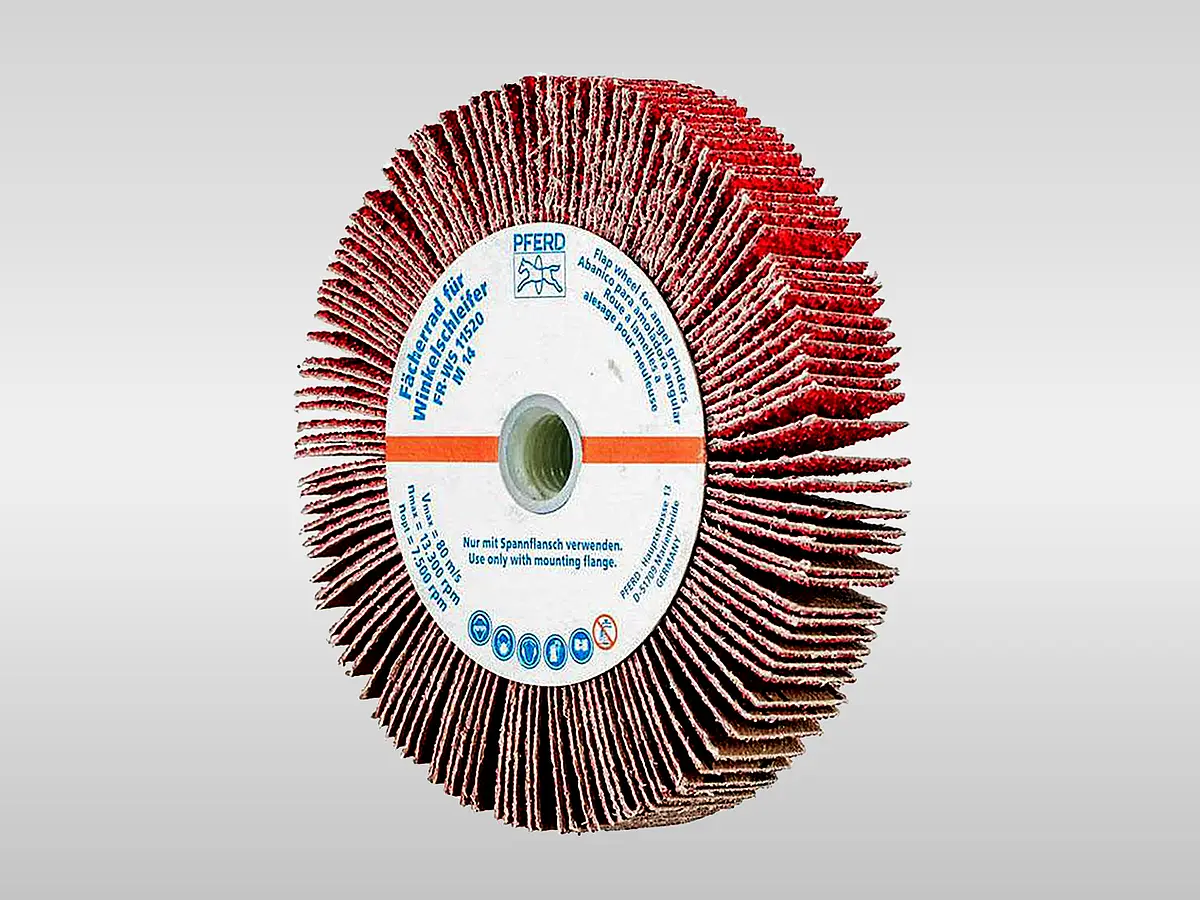
Flap wheels work on contours, edges and surfaces with flexible abrasive flaps. The range shown here consists of flap brushes; choose according to the material, initial surface, required finish and suitable machine mounting.
01
Selection criteria
Check flap construction, finish and mounting
Start with your workpiece: which material and geometry are involved, which marks need removing, and what surface pattern should remain? Assess the tool currently in use alongside contact pressure, machine guidance and tool life. Depending on the design, coated abrasive flaps can be used for material removal and blending; versions containing non-woven abrasive are more focused on cleaning and finishing. Grit or grade alone cannot replace this distinction. Match diameter, working width and shaft or system mounting to the machine.
02
FLAP BRUSHES
Flap brushes in the range
The system listing shows flap brushes with abrasive flaps, non-woven abrasive or a combined construction. Check the specific version and mounting in the product data.
No products found
No products are currently listed in this category. Request a call back and we will help you find the right product.
Request a callback03
FLAP WHEEL SELECTION
From the starting surface to the required finish
For more intensive material removal on contours, flaps made of abrasive cloth may be suitable; the listed 3M flap brush 339 is an example with aluminium oxide and a shaft. Where an existing grain pattern needs blending after weld treatment or a surface defect needs removing, 3M describes Scotch-Brite CB-ZS as a combination of non-woven abrasive and coated abrasive. For a finer grain pattern, the manufacturer describes FF-ZS as an all non-woven flap brush. These tasks are distinct: select the specific version according to material, initial surface, desired stock removal, finish and tool life in the actual process.
The mounting must fit the machine: a shaft and the Roloc system are different designs. Do not infer grit or operating conditions from a product family name alone. If the current tool removes too much material, loads up quickly or produces an inconsistent grain pattern, tell us the material, workpiece geometry, machine and affected process step. For other abrasive flap tools, see flap wheels; for different brush designs, see abrasive brushes.
04
QUESTIONS ABOUT FLAP WHEELS
How do abrasive flaps differ from non-woven flap brushes?
Coated abrasive flaps and non-woven abrasive flaps serve different purposes. The listed 3M flap brush 339 uses aluminium oxide on abrasive cloth for material removal and finishing on contours. Scotch-Brite FF-ZS is described as a non-woven flap brush for producing a fine grain pattern. CB-ZS combines non-woven abrasive with coated abrasive to remove surface defects and blend an existing grain pattern. The deciding factors are how much material needs to be removed and which surface is required afterwards.
How should you choose a grit or grade for a flap wheel?
Base your choice on the initial surface condition and the required result. The catalogue lists 3M flap brush 339 in variants with different P grits; Scotch-Brite non-woven flap brushes also use grades. These markings describe different tool constructions and are not directly interchangeable. Check on your workpiece whether the chosen construction achieves the required removal without changing the intended grain pattern. Include the material, pressure, tool guidance and service life of the tool currently in use in that assessment.
Which mounting must match the machine?
The mounting of the particular brush must fit the intended machine. Depending on the variant, the 3M flap brush 339 listed here has a shaft, whereas the Scotch-Brite Roloc flap brush uses a Roloc interface. Diameter and working width also vary between versions. Check the product data and machine mounting together before selecting a grit. The description “flap brush” by itself establishes neither mounting compatibility nor a general approval for your operating conditions.
When is a flap brush useful for blending a grain pattern?
When an existing grain pattern needs blending or a light surface defect needs removing after processing, a tool designed for that task is worth evaluating. 3M explicitly describes these uses for Scotch-Brite CB-ZS, which combines non-woven abrasive and coated abrasive. The manufacturer describes FF-ZS for a finer grain pattern. Heavy material removal, removing a weld and final finishing are separate process steps. Evaluate the result on the actual material and against your required surface.
Can a finished flap wheel be cut to a custom size?
Custom processing of finished flap brushes cannot be promised as a standard service. Krückemeyer GmbH processes coated abrasives as input materials; depending on the material and application, these can become other forms such as abrasive belts, discs or strips. Suitability of the backing, geometry and production method is assessed individually. If your existing flap brush does not fit because of its size, mounting or finish, first tell us about the workpiece and process. We can then examine a suitable product variant or a different abrasive form.
05
Request advice
Tell us the material, workpiece geometry, flap brush currently used, machine and required grain pattern. We will review the flap construction, mounting and suitable version with you.
Select a flap wheel for your application
Send us your machining task and details of the tool currently in use. We will review material removal, finish and machine mounting with you.

ABRASIVES ADVICE
Jürgen Müller
Contact for products
Jürgen Müller helps you choose according to the material, machine and required grain pattern.
Advice and sales to business customers only!